| Brand/Manufacturer | Mindray |
|---|---|
| SKU | MX8 |
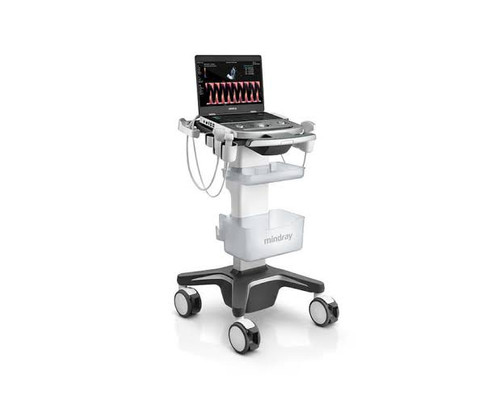
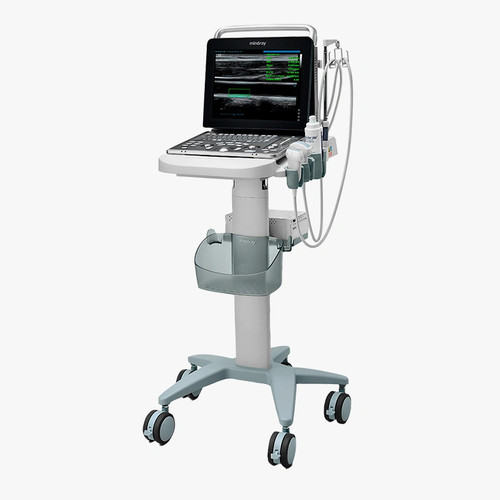
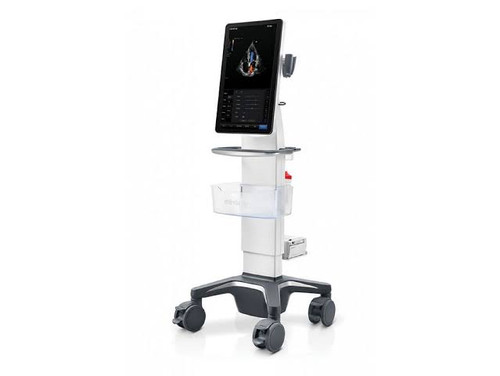
The Mindray MX8 Portable Ultrasound System is a specialty-focused, laptop-style ultrasound platform designed for musculoskeletal and cardiovascular imaging. Available in dedicated MX8 MSK and MX8 Cardiovascular configurations, the system combines Mindray’s ZONE Sonography® Technology+ (ZST+), AI-enhanced workflow tools, advanced imaging applications, and a highly portable design. At just 6.6 lb and 1.7 inches thick, the MX8 is one of Mindray’s lightest laptop-style ultrasound systems, making it well suited for private practices, specialty clinics, bedside imaging, and environments where clinicians need advanced ultrasound capabilities without a full-size cart system.
The MX8 is powered by Mindray's ZONE Sonography Technology+, a software-based ultrasound architecture designed to deliver a balance of image resolution, tissue uniformity, and processing performance.
Rather than relying exclusively on conventional line-by-line beamforming, ZST+ provides the technological foundation for the MX8's advanced imaging and workflow capabilities. Mindray designed the platform to improve reproducibility, productivity, and consistency between users, particularly during challenging specialty examinations.
Unlike a conventional general-imaging system designed to cover as many specialties as possible, Mindray currently positions the MX8 in two specialized configurations:
MX8 Musculoskeletal Ultrasound System — optimized for MSK imaging, ultrasound-guided procedures, superficial anatomy, and related specialty applications.
MX8 Cardiovascular Ultrasound System — optimized for cardiac and vascular examinations with dedicated cardiovascular imaging, measurement, and analysis technologies.
This allows practices to select an MX8 configuration built around their primary clinical workload.
The MX8 MSK configuration is designed specifically for musculoskeletal examinations and procedures. Mindray offers an extensive portfolio of linear transducers for imaging both superficial and deeper structures, with frequencies ranging from 5–1 MHz to 20–5 MHz.
Compatible applications can support detailed visualization of:
Mindray's current MX8 clinical examples include imaging of the flexor tendon, median nerve, patellar tendon, bicipital groove, femoral head and hip, and finger joint.
A major advantage of the MX8 MSK configuration is its selection of high-frequency linear transducers.
Current compatible MSK probes include the L16-4Hs, L12-3RCs, L20-5s, L15-3RCs, L11-3VNs, L14-6Ns, L9-3s, and L13-3Ns, depending on the desired application and configuration.
The L12-3RCs linear transducer incorporates three programmable buttons, providing convenient access to selected system controls while the clinician remains focused on scanning.
The MX8 MSK's combination of high-frequency transducers, portable design, and workflow technologies makes it particularly useful for ultrasound-guided MSK procedures.
Depending on the selected transducer and accessories, compatible probes support biopsy guides and procedural applications. The system's portability and touchscreen interface also allow it to be positioned close to the patient in examination and procedure rooms.
Potential applications include ultrasound-guided injections, aspirations, nerve blocks, and other procedures where real-time visualization of superficial anatomy is required.
Second-generation iVocal uses AI-based voice-recognition technology to enable hands-free control of supported ultrasound functions.
Mindray specifically highlights this capability for single-operator and sterile environments, where repeatedly reaching for system controls may disrupt workflow.
Voice control can help the clinician remain focused on the patient and transducer while reducing unnecessary interaction with the console.
iWorks Protocols provide standardized examination workflows for common MSK applications.
Mindray identifies dedicated protocols for the:
These protocols are designed to help clinicians standardize examinations and reduce exam time, which can be particularly useful in high-volume orthopedic, sports medicine, and MSK practices.
The MX8 Cardiovascular configuration combines the portability of the MX8 platform with dedicated cardiac and vascular applications.
Mindray's compatible transducer portfolio includes phased-array, linear, TEE, and non-imaging CW transducers for adult cardiac, pediatric cardiac, and vascular applications.
This makes the cardiovascular MX8 suitable for practices that need advanced echocardiography capabilities but value the mobility of a compact laptop-style system.
The MX8 Cardiovascular System supports Left Ventricular Opacification (LVO) with Stress Echocardiography.
During stress examinations, LVO can improve differentiation between tissue and the blood pool to enhance visualization of the endocardium. Mindray's package includes customizable user protocols, flexible wall-motion scoring, and comprehensive reporting capabilities.
This extends the MX8 beyond routine cardiac imaging into more advanced echocardiography workflows.
Tissue Tracking with Quantitative Analysis (TTQA) allows clinicians to analyze cardiac tissue motion by tracking speckle displacement from frame to frame.
The technology is non-angle-dependent and provides onboard analysis, allowing assessment to be performed directly at the bedside without requiring a separate workstation for the initial analysis.
Mindray offers a broad probe portfolio for the cardiovascular MX8, including:
This selection allows the cardiovascular MX8 to be configured for both routine and more specialized cardiovascular examinations.
Portability is one of the MX8's defining advantages. The system weighs only 6.6 lb and measures approximately 1.7 inches thick, allowing clinicians to carry it between examination rooms or use it in locations where a traditional cart-based ultrasound system may be cumbersome.
A 15.6-inch LED display provides a large imaging surface despite the system's compact dimensions, while the customizable touchscreen provides access to system controls without requiring the footprint of a conventional ultrasound console.
The MX8 includes a built-in battery capable of providing approximately 90 minutes of continuous scanning in B-Mode under Mindray's specified conditions.
For environments requiring longer mobile operation, an optional U-bank battery companion can extend continuous scanning to up to four hours.
This makes the MX8 particularly useful for mobile clinical workflows and locations where continuous access to AC power may not be convenient.
Mindray's Living Technology program is designed to protect the long-term value of the MX8 by providing a software-based pathway for future enhancements.
Mindray describes Living Technology as an approach that enables compatible ultrasound systems to receive upgradeable software enhancements based on their core imaging technologies, helping systems remain current as Mindray develops additional capabilities. New application packages and hardware may require separate purchases.
The Mindray MX8 is ideal for: