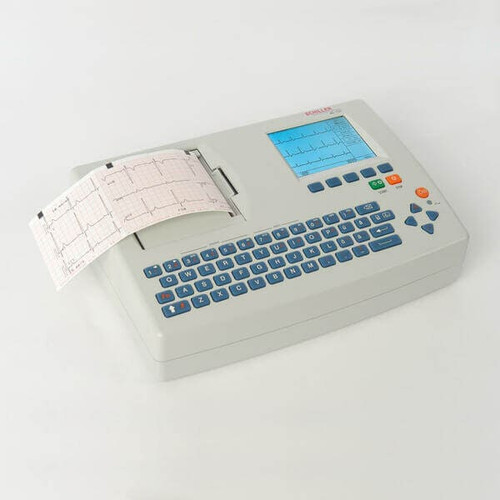
| Brand/Manufacturer | Schiller |
|---|---|
| SKU | 0A.110000 |
The SCHILLER CARDIOVIT AT-180 Resting ECG Machine is a high-performance electrocardiograph designed for comprehensive cardiac diagnostic testing in hospitals, cardiology practices, and outpatient facilities. Featuring an 18.5-inch high-resolution touchscreen, simultaneous 12-lead ECG acquisition, integrated full-size thermal printer, and advanced ECG analysis capabilities, the AT-180 combines powerful diagnostic functionality with an intuitive clinical workflow.
Designed as a versatile cardiac diagnostic workstation, the CARDIOVIT AT-180 offers a 32,000 Hz ECG sampling rate, resting rhythm recordings of up to 20 minutes, automatic lead reversal detection, and anatomical electrode placement guidance. Optional 16-lead ECG acquisition, signal-averaged ECG, and exercise testing capabilities allow facilities to expand the system to meet additional diagnostic requirements.
With built-in Ethernet and Wi-Fi connectivity, electronic worklist functionality, and compatibility with supported EMR/HIS systems, the AT-180 helps streamline ECG acquisition, interpretation, reporting, and patient data management.
The CARDIOVIT AT-180 provides simultaneous 12-lead ECG acquisition to record and evaluate the electrical activity of the heart.
Its advanced signal acquisition system captures detailed ECG waveforms for clinical review, supporting routine cardiac examinations and assessment of heart rhythm abnormalities.
The AT-180 is intended for use by trained healthcare professionals during adult and pediatric resting ECG examinations.
The AT-180 features a large 18.5-inch multi-touchscreen with a resolution of 1366 × 768 pixels.
The expansive display provides convenient visualization of ECG waveforms, patient information, examination controls, and diagnostic results.
Clinicians can review multiple ECG channels simultaneously, navigate recordings, and access diagnostic functions through SCHILLER's intuitive user interface.
The CARDIOVIT AT-180 incorporates a 32,000 Hz sampling rate to support detailed cardiac signal acquisition.
This high sampling frequency supports the system's advanced ECG analysis capabilities, including arrhythmia assessment when the appropriate software is installed.
The AT-180 includes an interactive anatomical hook-up adviser designed to help clinicians position ECG electrodes correctly.
The system displays a three-dimensional anatomical model that can be rotated and enlarged for improved visualization.
Color-coded waveform indicators provide feedback about electrode connections and signal quality before recording begins.
This feature helps clinicians identify potential problems and supports consistent ECG acquisition.
The CARDIOVIT AT-180 incorporates automatic lead reversal detection.
The system can identify suspected electrode connection errors before ECG acquisition, allowing clinicians to check and correct lead placement.
This helps reduce repeat examinations caused by incorrect electrode connections.
The AT-180 supports resting rhythm recordings of up to 20 minutes.
Extended recordings allow clinicians to review cardiac electrical activity over a longer period than a conventional short resting ECG examination.
This capability is useful when additional rhythm information is needed during an ECG assessment.
SCHILLER's ECG Framer function allows clinicians to create a standard 10-second resting ECG from an extended rhythm recording.
This provides flexibility when reviewing rhythm recordings and selecting a representative ECG segment for documentation.
The CARDIOVIT AT-180 can be expanded with optional 16-lead resting ECG acquisition and analysis.
Unlike systems that calculate additional leads from existing measurements, SCHILLER's optional 16-lead capability uses directly acquired ECG signals.
This provides additional diagnostic information for facilities requiring expanded ECG assessment.
The 16-lead function is an optional configuration and should not be assumed to be included with every system.
The AT-180 supports computerized ECG measurements and interpretation.
Depending on the installed software and applicable regulatory approvals, advanced diagnostic capabilities may include:
These functions help clinicians review and analyze cardiac recordings. Automated analysis is intended to support, not replace, professional interpretation.
The CARDIOVIT AT-180 includes a high-resolution thermal printer for producing ECG reports directly from the workstation.
The printer uses approximately 210 mm-wide Z-fold thermal paper and supports full-size ECG documentation.
This allows facilities to maintain printed ECG records while also supporting electronic reporting workflows.
The AT-180 features a full-size keyboard with a durable, replaceable protective cover.
The cover helps protect the keyboard against dust, dirt, and liquids while simplifying routine surface cleaning.
This design is particularly beneficial in busy clinical environments where equipment is used frequently.
The AT-180 supports internal storage for:
Stored examinations can be accessed for review and managed through supported reporting and data transfer workflows.
The CARDIOVIT AT-180 includes standard Ethernet and secure Wi-Fi connectivity.
These capabilities support bidirectional communication with compatible clinical information systems and ECG data management platforms.
Connected workflows can help reduce manual data entry and simplify electronic access to diagnostic ECG reports.
The AT-180 supports electronic integration through compatible SCHILLER connectivity solutions.
Depending on the installed interfaces, supported workflows may include:
Specific integration capabilities depend on the receiving system, network configuration, and selected software.
Although primarily designed for resting ECG examinations, the CARDIOVIT AT-180 can be expanded with optional exercise ECG testing functionality.
With the appropriate software and compatible exercise equipment, the system can support exercise testing workflows.
Exercise testing is not a standard capability of every AT-180 configuration.
The CARDIOVIT AT-180 supports operation using AC power or internal rechargeable batteries.
Published technical documentation describes approximately four hours of battery operation under specified test conditions.
Battery operation provides additional flexibility for moving the system between patient-care locations.