| Brand/Manufacturer | Midmark |
|---|---|
| SKU | Midmark 630 HUMANFORM Procedure Chairs |
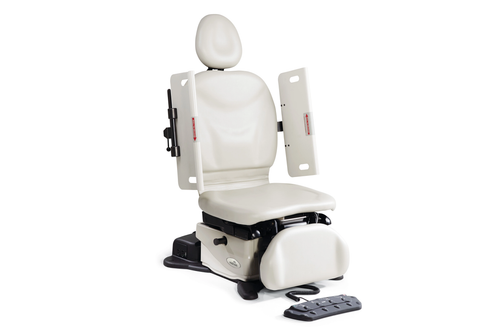
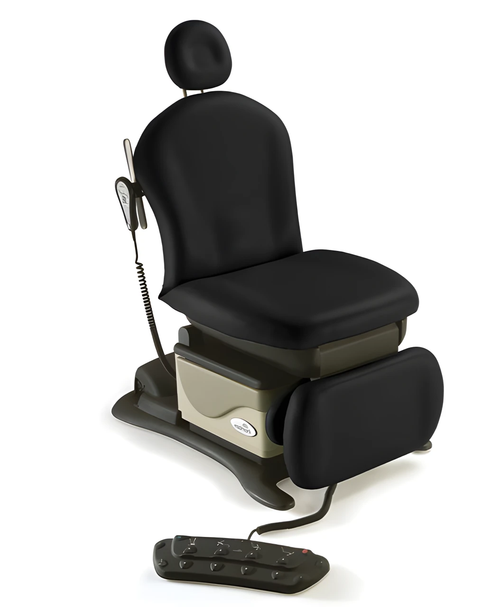
The Midmark 630 HUMANFORM® Procedure Chair is a fully powered procedure chair designed to improve patient accessibility, comfort, provider ergonomics, and procedural positioning in outpatient clinical environments. With powered height, back, foot, and tilt adjustments, the 630 allows clinicians to position patients precisely for a wide range of procedures while maintaining clear access to the treatment site. Midmark’s HUMANFORM design incorporates technologies such as Motion Profiling®, Active Sensing Technology®, and the Premium Comfort System®, along with a 19-inch low seat height and 650 lb patient weight capacity.
The Midmark 630 provides powered height, back, foot, and tilt adjustment, giving clinicians control over multiple aspects of patient positioning without requiring manual repositioning of the chair.
The powered platform allows the patient to transition between seated, reclined, flat, and procedure-oriented positions while helping clinicians establish an appropriate working height and angle for the procedure being performed. Midmark specifically designed the chair to provide unobstructed access to patients and a clear view of procedural sites while helping providers maintain more ergonomic working positions.
A defining feature of the HUMANFORM design is Midmark's Motion Profiling technology.
Rather than simply moving the back section independently, Motion Profiling coordinates chair movement as the patient's position changes. It is designed to help maintain head and back support as the back section raises or lowers, reducing the need for patients to continually reposition themselves.
This humanlike movement can be particularly beneficial during longer procedures or examinations involving patients who have difficulty repositioning independently.
The Midmark 630 incorporates Active Sensing Technology (AST) to add an additional level of protection during powered chair movement.
AST is designed to detect potentially disruptive impact and pause chair movement when an obstruction or potentially harmful impact is detected. This can help protect patients, clinicians, equipment, and other objects positioned around the chair while powered adjustments are being made.
Patient accessibility is a major focus of the Midmark 630 design. Non-rotational models lower to a 19-inch seat height, which falls within the 17- to 19-inch low transfer-height range referenced by the U.S. Access Board in Midmark's accessibility materials.
The chair can also be positioned into a low, flat transfer surface, helping patients transfer onto and off the chair with less assistance.
Combined with its 650 lb weight capacity, the 630 is designed to accommodate a broad patient population, including patients with limited mobility.
The Premium Comfort System combines contoured upholstery with an adjustable footrest to provide a supportive, chair-like feel.
Rather than placing the patient on a conventional flat procedure surface, the upholstery is shaped to help cradle and support the patient while the chair transitions between positions.
This patient-centered design can be particularly useful for procedures requiring patients to remain in the chair for extended periods.
The Midmark 630 features a powered foot extension that allows the footrest to extend at the touch of a button.
This provides additional support for taller patients and allows clinicians to adjust the overall patient support surface without manually extending or repositioning the foot section.
When positioned flat, the 630 provides a patient support surface approximately 72 to 76 inches long, depending on configuration.
Programmable 630 configurations provide four customizable positions, allowing frequently used chair positions to be stored for quick recall.
This can be particularly valuable in specialty practices where clinicians repeatedly use similar positions throughout the day. Instead of individually adjusting height, back, foot, and tilt for every patient, preferred procedural positions can be recalled more efficiently.
Non-programmable configurations are also available for facilities that do not require position memory.
The Midmark 630 is available with optional 350-degree chair rotation, providing additional flexibility in procedure rooms where clinician access around the patient is important.
Rotation can allow clinicians to change the patient's orientation without repositioning the entire chair base, which may be particularly useful in smaller procedure rooms or environments containing additional equipment.
The rotational configuration adds approximately 3.5 inches to the chair's minimum and maximum seat heights. Standard non-rotational models have a 19- to 40-inch height range.
The Midmark 630 includes wired hand and foot controls as standard equipment, allowing providers to adjust chair positioning using the control method most appropriate for the procedure.
Optional wireless hand and foot controls are also available. Wireless controls can reduce cords around the procedure area and provide greater flexibility in where clinicians position themselves while adjusting the chair.
Stirrups are standard equipment on the Midmark 630, expanding its usefulness for procedures requiring lower-body positioning.
Combined with powered height, back, foot, and tilt adjustment, the stirrups make the chair adaptable for a broader range of specialty procedures without requiring a separate examination table.
The Midmark 630 is available with 28-inch or 32-inch upholstery widths, allowing facilities to choose the patient support surface appropriate for their patient population and procedure requirements.
Midmark currently offers numerous upholstery colors, including neutral, blue, green, gray, red, and earth-tone options, allowing healthcare facilities to coordinate the chair with the surrounding clinical environment.
Applicable standard 630 configurations include hospital-grade duplex electrical outlets on each side of the chair.
The integrated receptacles provide convenient access to power for compatible equipment used around the procedure chair, potentially reducing dependence on distant wall outlets and helping simplify equipment placement. Electrical outlets are not available on rotational or 230 V models.
The Midmark 630 can be configured with a variety of accessories to support different specialties and procedures.
Available accessories include:
This accessory ecosystem allows practices to adapt the same chair platform to different procedural workflows.
Midmark specifically designed the 630 for the expanding range of procedures being performed in outpatient clinical environments.
Its combination of powered positioning, patient accessibility, provider ergonomics, and specialty accessories makes the chair suitable for environments where clinicians require greater positioning flexibility than a conventional exam table can provide.